October 16, 2008
Circles and lines
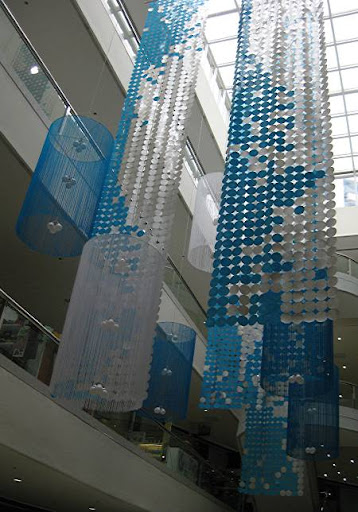
The current decoration in the atrium of The Podium, one of two upscale malls in the Ortigas Center. Simple and elegant. I'm glad they didn't decorate for Halloween—some of the shops and restaurants did, and that's enough.


October 15, 2008
Power struggle
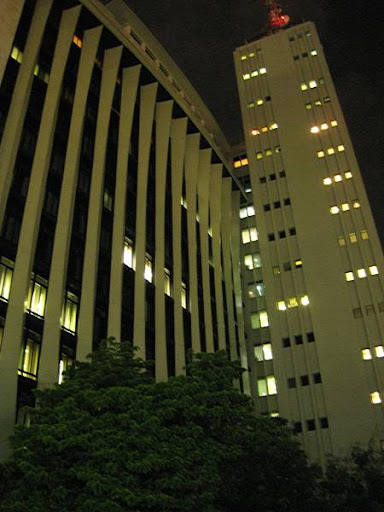
The Manila Electric Company, better known as Meralco, is the only power distributor in Metro Manila. In fact, it is the only power distributor in almost half of Luzon, the largest island in the Philippines. It was set up in 1903 by an entrepreneur from Detroit mainly to operate Manila's electric tramway system, with power generation and distribution only as an extension of the transportation business ('Meralco' comes from the company's original name: Manila Electric Railroad and Light Company). During WWII, the company's assets were seized by the Japanese. In 1962, Eugenio Lopez Sr. bought the company and it became Filipino-owned for the very first time. In 1972, when Ferdinand Marcos declared Martial Law, the government again forcibly seized control of Meralco and it was returned to the Lopez family only after the People Power Revolution in 1986. This year, there is another struggle for control of the power company—between the Lopez family and the Government Service Insurance System, one of the major stock holders of Meralco. Accusations are being hurled all over the place and, for a time, it was always front page news. The news may have moved on to the next big thing, but I don't think the power struggle has been resolved yet. The simple but elegantly curved building is the building most associated with Meralco and is located in the company's large complex in the Ortigas Center.
October 14, 2008
Amusing
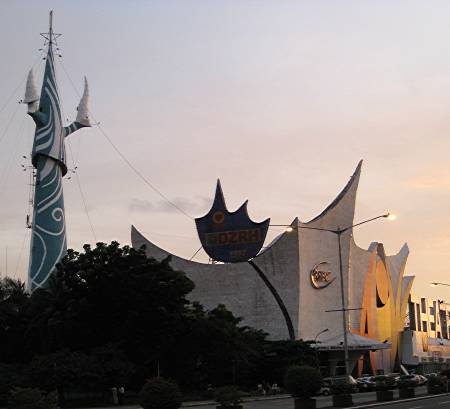
This is the front of the funny-looking building I posted yesterday. It's the entrance of the Aliw Theater, and I'm sure you all see the letters. Aliw is a Tagalog word which means entertainment, amusement. Most of the performances staged here are popular concerts, although it is also the main performance venue of Ballet Manila. I still say the building looks strange and gaudy. Okay, only on the outside, but still…

October 13, 2008
Spiky skyline
Right beside the elegant Cultural Center of the Philippines in Pasay City is a building which houses the radio station DZRH and the Aliw Theater. To tell you the truth, I already think that the building is horrendous and it's made even more so by that… that thing! I have no idea what it is. I always thought that it was just some attention-getting devise of Star City, an amusement park farther down the road. But the more I look at it, the more it looks like a radio antenna tower dressed up for Christmas. Or is it Halloween?

Find more Odd Shots—or post your own—at Katney's Kaboodle.
October 12, 2008
Opa!
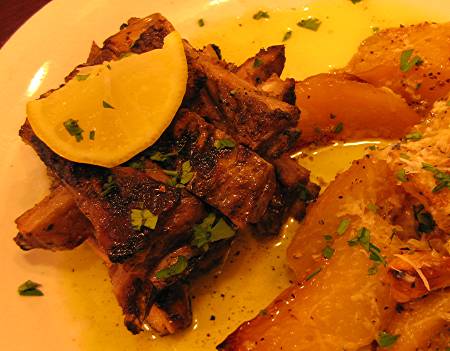
I've always maintained that Metro Manila is a foodie's heaven. One can easily eat out everyday in a different restaurant for an entire year, and I'm not counting branches of the same restaurant or the many holes-in-the-wall found throughout the metro. Cyma is a Greek restaurant that first opened its doors in Boracay Island, which has some of the Philippines' most famous and popular beaches. It now has three branches in Metro Manila: at Shangri-la Mall in Mandaluyong, Trinoma Mall in Quezon City, and Greenbelt 2 in Makati City. Executive Chef Robby Goco supposedly traveled all over Greece and the Mediterranean sampling and studying the dishes of the region for Cyma. I don't know how authentic the flavors are, but I have to say that I haven't eaten anything in Cyma that didn't taste great. Some dishes I like better than others, of course, but it's more a matter of personal preference than anything about the food itself. I'm a cheese fiend and would also rather have fish and seafood, so I'm not a good judge of meat dishes. I was with a self-confessed carnivore when we had this Paidakia: char-grilled lamb ribs. Cyma's servings are large—even the solo size—so we shared this, after an appetizer of Saganaki: flaming cheese. The lamb was served with Patates Fournou: potatoes marinated in lemon, garlic, oregano and extra-virgin olive oil, roasted, then topped with freshly grated Parmesan cheese.
October 10, 2008
Sunset cruise
This is the boat used for the daily sunset cruise of Manila Bay. An overcast sky does not discourage people.


Visit the Sky Watch Friday home page and tour the skies of our beautiful world.
October 9, 2008
Glorious wood
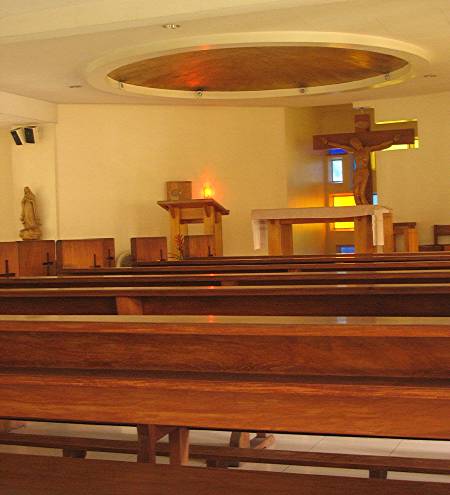
As a Catholic university, the Ateneo de Manila has several chapels aside from the Church of the Gesù which I've featured during the day and at night. One of my favorite chapels is the Immaculate Conception Chapel in the Loyola Schools. It was redesigned extensively in 2000 by architect Vincent Pinpin and looks very different from when we used to attend Sunday mass there when I was a kid. I love the simplicity of the chapel now, with all its beautiful wood, big windows at the sides to let in lots of sunlight, and the few panes of colored glass up front behind the altar. The crucifix rotates and on the other side is the resurrected Christ, used during the Easter season. The small statue of Mary is a replica of a bigger one which is probably as old as the university. The original statue used to stand in the grand staircase of the Intramuros campus in the late 1800s. It either survived the 1930s fire and transfered to the entrance of the Padre Faura campus, or there was a second statue exactly like the first one. I don't know if I can ever find out for sure, but I do know that the Padre Faura statue was mostly destroyed during WWII. However, the upper portion was salvaged and when the university moved to Loyola Heights in Quezon City in the 1950s, the statue was restored by an alumni class that studied in the Padre Faura campus. That restored statue is now kept in the university archives.
October 8, 2008

October 7, 2008
Centennial
Since I mentioned Jose Rizal in my previous two posts, I might as well add a third and get him out of my system. Because he's a Philippine national hero, his image and name appears all over the country, especially in monuments and street names, whether he actually went to the place or not. Here, we see a bust of him through the gates of Palma Hall in the Diliman campus of the University of the Philippines (U.P.). When I was in college and visiting friends here, Palma Hall was the home of the College of Arts and Letters. Now, according to U.P. Diliman's website, it is the College of Social Sciences and Philosophy. We used to be able to pass through this gate too. I think it's permanently closed now, and only the gates at its sides are left open. My guess is it's to preserve Rizal's bust—you know what college kids can be like. U.P. was founded in June 18, 1908 and this year marked their centennial. Their official seal is composed of an eagle holding a shield with symbols for agriculture (inside the pyramid: a coconut tree, rows in a field, and something tied in a bundle), science (upper left: a book, an oil lamp with a flame, and a funny-looking flask which I remember from Chemistry lab), and engineering (upper right: a hammer, an anvil, and a wheel). At least, those are the symbols in this seal. Wikipedia has a picture of the seal on the gate of U.P.'s main library, and it sure looks different from this one. And it's the image on the library that was used when U.P. had its seal redrawn and registered in the Intellectual Property Office.


October 6, 2008
What does a basement look like?
And what's a theater post from me without a sneaky photograph? I showed you the posters of Dulaang U.P.'s "Isang Panaginip na Fili" yesterday. Here is the one-shot-only photo of the stage. [I really have to start remembering to change my camera's settings before we enter theaters!] Rizal began writing El Filibusterismo in 1887 when he was still in the Philippines but continued working on it while he was in Europe, finally finishing it in 1891. The play sets him in Paris, living in the basement of a friend's apartment. I think the set designer went a little overboard though—this looks more like a sewer than a basement! But I guess I can understand the exaggeration. Since most Filipino homes don't have basements, the designer wanted to make sure that the audience understood that Rizal was writing his second novel in a less-than-ideal environment.


October 5, 2008
Keep on dreaming, Pepe
Philippine national hero Dr. Jose P. Rizal and his two novels Noli Me Tangere and El Filibusterismo seem to be popular topics not just in history and literature classes here but also in plays. In August, we watched the Philippine Educational Theater Association's "Noli at Fili: Dekada 2000," a modern interpretation of the two novels, and the same theater group is currently staging "Batang Rizal," which discusses the ideas of heroism and nationalism from the point of view of children, one of whom is the child Jose "Pepe" Rizal. Dulaang U.P., the resident theater group of the state University of the Philippines, recently staged "Isang Panaginip na Fili" (A Dream of Fili). Basically, the play is just a dramatization of Rizals' entire second novel. What makes it different is the fact that it is a musical, and the novel's story is interspersed with scenes where Pepe discusses his novel-in-progress with a friend. In the end, they differ in their ideas about how Pepe should end his novel. Tunying wants him to choose the way of weapons and warfare. But Pepe—much like his other choices in life—in the end decides to reject violence. It's a slower and more difficult path, and many of the social ills of the Philippines that Rizal wrote about still exist to this day. But, as the play exhorts in the end: Keep on dreaming, Pepe, and maybe one of these days, your dream of justice, freedom and equality for Filipinos just might come true. Especially if enough Filipinos dream with him, I think.


October 4, 2008
My Manila
There is a reason why I titled my blog "My Manila" and never changed it even after it was accepted into the City Daily Photo community. Metro Manila is composed of 17 cities and municipalities, after all, and I move in only a tiny part of it. And I mean that in both the geographical sense and, much as I hate to admit it, also in an economic sense. The World Bank estimates that 40% of Filipinos live in poverty. And if the World Fact Book's July 2008 population estimate is correct, that's a whopping 38.4 million people! In Metro Manila, the hard fact of poverty can be seen in large squatter communities, homeless people sleeping under bridges and in parking lots at night, and men, women and children selling flowers, candies, cigarettes and rag rugs on the streets. Unfortunately (or fortunately, depending on your point of view), these are things I have had no opportunity to take pictures of—for various reasons which will take too long to explain—though I know I have hinted at it several times already. Here, finally, is more than a hint: a man rooting through garbage bags to get boxes, cans and bottles that he can sell to a recycling center. I wonder if he even makes 40 pesos a day doing this…


October 2, 2008
An artist's mangrove
Filipino artist Impy Pilapil, best known for her glass and stone sculptures, has had an interactive installation in the campus of the Ateneo de Manila University since February titled "Interactive: 12 Human Senses." Aside from providing a lovely touch of color to the grounds, it was actually fun playing with them. My favorites were two musical pieces. I'm speaking in the past tense because I discovered last week that they're being removed one by one. First to go was "Music Chamber," my favorite. I used a friend's photo of it to illustrate an April post in my other blog. This photo shows the bamboo "Chime Halo," the second of my favorites, and the showcase piece "The Mangrove – Nature's Embrace." I took this photo last week and when I passed by the area early this week, the colorful mangrove was gone. I'm going to miss them.


October 1, 2008
Graffitied wall
THEME DAY: LINES • I've featured Bookay-ukay, the used-books store near our home, a couple of times, during their opening day and about two months after that. This is the first time I'm showing their nuclear green, graffiti-as-you-will wall. Most of the art is line drawings but a few photographs have made their way onto it. And if you can't find a book that interests you, you just might find some lines of text here that will.

It's fun seeing the different ways CDP bloggers interpret the month's theme. Some are literal, some artistic, some witty, some downright cheeky. Click here to view thumbnails for all participants.

It's fun seeing the different ways CDP bloggers interpret the month's theme. Some are literal, some artistic, some witty, some downright cheeky. Click here to view thumbnails for all participants.
Subscribe to:
Posts (Atom)