
April 14, 2010
In our neighborhood
This is a typical section of our village's main road and shows well the wide mix of residents in our barangay. On the left is a big house, probably with no garden at all because the house takes up the entire lot; the house isn't new but it is very well maintained. Next is a smaller house almost hidden by the repair shop on one side and a profusion of plants on the other; the owner of the house either owns the repair shop or leases out the space for extra income. On the right is a bakery, which also sells softdrinks and other snacks; no fancy pastries and cakes here—just soft buns of different kinds: plain, buttered and sugared, or flavored with ube or chocolate. Our main road is supposed to have four lanes but as you can see, the businesses have staked out parking spaces from the outer lanes.


April 13, 2010
Broccoli trees
Walking around the perimeter of Timberland Sports and Nature Club (see yesterday's post), an office mate pointed out these trees on the slope of the next hill. Since it is the middle of summer in the Philippines, most of our grasses and plants are brown, pale, thin, dry or downright bald, so these trees are striking for their lush, bright green leaves. They were too far to identify with any certainty, but another office mate said that they looked like broccoli and thus were they christened.

Kidding aside, my guess is that they're mango trees.
Kidding aside, my guess is that they're mango trees.
April 12, 2010
Lazy day with a view
For our office's annual summer outing, we spent one day in Timberland Sports and Nature Club in the town of San Mateo in the province of Rizal. It is on one of the foothills of the Sierra Madre mountain range and has a spectacular view of Metro Manila.

Timberland is a members-only club and is 45 minutes away from Quezon City. It has a wide range of sports and leisure facilities and except for a few small details, it seems that the developers have remained true to their vision as presented in the scale model.

Can you locate where this garden is in the model?

I'm sorry I don't have more photos of the club, but it's as my title says: I decided to indulge my lazy side that day. Swimming pool, whirlpool bath, steam bath, sauna—and my camera isn't waterproof.
Timberland is a members-only club and is 45 minutes away from Quezon City. It has a wide range of sports and leisure facilities and except for a few small details, it seems that the developers have remained true to their vision as presented in the scale model.
Can you locate where this garden is in the model?
I'm sorry I don't have more photos of the club, but it's as my title says: I decided to indulge my lazy side that day. Swimming pool, whirlpool bath, steam bath, sauna—and my camera isn't waterproof.
April 11, 2010
The resurrection and the life
This hopeful image of the resurrected Christ greets visitors and mourners at the entrance of the crypt of Our Lady of Mount Carmel church in New Manila, Quezon City. The odd lighting pattern comes from the fact that the columbarium is in the basement of the church and fluorescent tubes had to be installed behind the panels. Nevertheless, I think that the stained glass is beautiful.

April 10, 2010
Leisurely breakfast
I've already shown you the striking spiral sculpture and staircase of Sofitel Manila's Spiral restaurant. We are looking inside from its outdoor dining deck, which is perfect for an early morning breakfast when it's not the rainy season. The sound of falling water from this ornamental reflecting pool and from the waterfall of the lagoon-shaped swimming pool is very soothing.


See what's reflecting what at James' Weekend Reflections.
April 9, 2010
Global support
This is a slightly different view of the residential and commercial condominiums in Eastwood City from the photo which I posted back in October. Eastwood was one of the first land developments in Manila that specifically targeted the business process outsourcing industry, providing their buildings with advanced high-bandwidth and fiber optic telecommunications systems. Dell International Services, which provides customer care and other support services for Dell users, has a center in the Eastwood City CyberPark.


Visit the Sky Watch Friday home page and tour the skies of our beautiful world.
April 8, 2010
Lock me up!
Every now and then, our university has problems with thieves getting inside the campus. And it doesn't help the situation when students leave their things on benches or leave their cars unlocked. The latter got so bad two years ago that our security guards were spending more time checking for unlocked cars than guarding against strangers (i.e., no IDs). Yes, we all know that it shouldn't be the responsibility of the school to play babysitter for careless students, but it does become the school's problem when things get stolen inside the campus. So at the start of the past school year, the university put up reminder banners in all of the parking lots, and this simple and inexpensive solution actually helped. The incidence of unlocked cars dropped dramatically and I don't remember reading a single report about car stereos or laptops left inside cars getting stolen. I think it helped that the cartoon car looks so cute and worried. How can you neglect the safety of your pet car when he's looking at you like that?

April 7, 2010
I don't want to meet their cousins
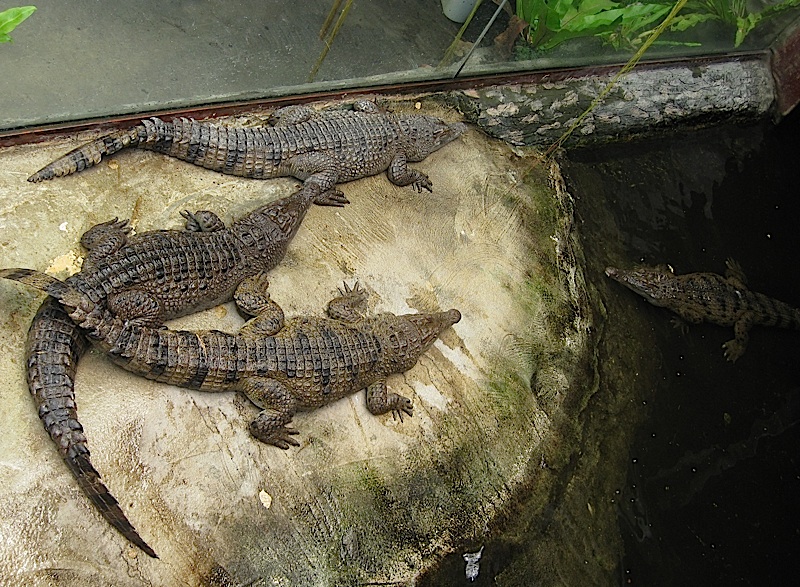
The Philippine crocodile (Crocodylus mindorensis) is a relatively small freshwater crocodile found only in the Philippines and is named after the island of Mindoro in Luzon. The largest specimens do not grow longer than 3 meters (10 feet) and most are smaller. It is in the critically endangered list of the International Union for Conservation of Nature (IUCN) though thankfully, several conservation societies have created captive breeding and releasing programs for it. These Philippine crocodiles are in the Agos (flow) section of the Manila Ocean Park.
Pinoy Trivia: The Tagalog word for crocodile is buwaya, which is the most common term and image we use to depict corrupt law enforcers and politicians who prey on innocent people. Poor crocodiles.

Pinoy Trivia: The Tagalog word for crocodile is buwaya, which is the most common term and image we use to depict corrupt law enforcers and politicians who prey on innocent people. Poor crocodiles.
Natural or man-made, take a refreshing dip in Watery Wednesday.
April 6, 2010
Ancient methods
When the Spaniards arrived in our islands in the 16th century, they discovered indigenous peoples that were well-organized into independent villages called the barangay (which is still the word we use for the smallest unit of our government). The word comes from the Austronesian word for sailboat, balangay or balanghai, a prehistoric wooden sailboat used by many of the island peoples of Southeast Asia and Oceania.

In the 1970s, nine of these balangay were discovered off the coast of Butuan City in the province of Agusan del Norte by archeologists of the National Museum. Only three have been excavated so far. One is still being reconstructed; the older of the other two, dated at 320 CE, is displayed in a museum in Butuan. This one is the third, dated at 1250, and is in the maritime hall of the Museum of the Filipino People. Only a few pieces of the boat survived its centuries-long immersion but the museum reconstructed a large part of the hull so visitors can better appreciate what it looks like.

Last year, a group of Filipino adventurers from the teams that scaled Mt. Everest in 2006 and 2007 decided to recreate a balangay using the same wood and construction methods that our ancestors would have used, and sail it using only the navigation methods available to the earliest mariners. The first voyage will be in Philippine waters, the second will be around Southeast Asia, and the third—the most ambitious of all—will be to sail to Madagascar. They are currently in the middle of the ninth leg of their ten-leg Philippine journey. If you're interested in their adventure, you can visit the Voyage of the Balangay website or follow them on Twitter, Facebook and YouTube.
In the 1970s, nine of these balangay were discovered off the coast of Butuan City in the province of Agusan del Norte by archeologists of the National Museum. Only three have been excavated so far. One is still being reconstructed; the older of the other two, dated at 320 CE, is displayed in a museum in Butuan. This one is the third, dated at 1250, and is in the maritime hall of the Museum of the Filipino People. Only a few pieces of the boat survived its centuries-long immersion but the museum reconstructed a large part of the hull so visitors can better appreciate what it looks like.
Last year, a group of Filipino adventurers from the teams that scaled Mt. Everest in 2006 and 2007 decided to recreate a balangay using the same wood and construction methods that our ancestors would have used, and sail it using only the navigation methods available to the earliest mariners. The first voyage will be in Philippine waters, the second will be around Southeast Asia, and the third—the most ambitious of all—will be to sail to Madagascar. They are currently in the middle of the ninth leg of their ten-leg Philippine journey. If you're interested in their adventure, you can visit the Voyage of the Balangay website or follow them on Twitter, Facebook and YouTube.
April 5, 2010
Don't blame the rains
Because of the long and wide Pasig River, which connects Manila Bay on the west and Laguna de Bay in the northeast, many cities in Metro Manila are crisscrossed by its numerous estuaries and tributaries. Unfortunately, with the fast and uncontrolled growth of this largest of the Philippines' urban centers during the sixties and seventies, the river system was completely neglected. The esteros of the cities of Manila, Makati, San Juan, Mandaluyong, Pasig, Taguig and Marikina are little more than open sewers. This particular garbage-choked estuary is in Binondo, Manila. It will take much more discipline and political will than we have shown so far to rehabilitate this very important resource. And people wonder why we always get floods during the rainy season.

April 4, 2010
Glory and praise
Another lovely sunset at Manila Bay. It would have been more fitting if this were a sunrise, but since that's next to impossible for me, I thought this would be a good enough choice for today. I've always wanted to get a photo of sunlight streaming through a break in the clouds, and now I have. Happiness.


A blessed and joyful Easter to everyone!
Urban or rural, natural or man-made, take a sightseeing tour of our world's diverse scenery!
April 3, 2010
Hot off the griddle
Filipinos don't need much of a reason to gather around food. But balikbayan (returning countrymen) family and friends are always an excuse to eat at the best restaurants. So when a friend from college visited from Canada, a group of us got together at a teppan or hibachi room of Kimpura, one of the oldest Japanese restaurants in Metro Manila. You can see some of my friends reflected in the mirrored walls.

See what's reflecting what at James' Weekend Reflections.
April 2, 2010
No mass
Good Friday is a holiday observed by most Christians, commemorating the passion and crucifixion of Jesus Christ and his death at Calvary. Unlike during other holy days, there will be no masses in Roman Catholic churches anywhere (nor tomorrow, Holy Saturday). Services will still gather people together in churches; however, the focus will be on mourning Jesus' death and contemplating his sacrifice. Here in the Philippines, quite a few people still recite the Pasyon, a poetic narrative of Jesus' passion, death and resurrection, in a custom which dates back to the 18th century; and many more will go through the Stations of the Cross. Though it is a school church and not a parish church, the Ateneo Church of the Gesù will also have its own Good Friday service. This is my view of the church everyday when I leave work in the early evening—though the color of the sky isn't always this odd but pretty shade.

April 1, 2010
I heart…
THEME DAY: RED • Red packages filled with cookies on the red mahogany-stained shelves of Sugarhouse, which opened its first cake shop in Makati City in 1983. I remember the big fuss that everyone made about it because of its French Apple Pie, Strawberry Shortcake, Chocolate Mousse, Peach Walnut Pie and Blueberry Cheesecake—extremely rare treats in Manila back then. Competition is much tougher nowadays, but Sugarhouse is still around and doing quite well. In fact, they currently have sixteen branches all over Metro Manila, from kiosks selling only cakes, pastries and cookies to full-service restaurants with a wide menu. Cinnamon Twists or Chocolate Chip cookies anyone?

See red! Click here to view thumbnails for all participants.
See red! Click here to view thumbnails for all participants.
Subscribe to:
Posts (Atom)