Showing posts sorted by relevance for query "Rizal Library". Sort by date Show all posts

January 6, 2010

Elemental

One of the stone and metal sculptures of Filipino artist Impy Pilapil graces the main entrance of the new Rizal Library of the Ateneo de Manila University. Titled "Wind and Soul," it stands in the middle of a small water feature, just one of many in this proudly green building. The aesthetically-pleasing water features, which use reclaimed rainwater, are part of a system which helps control the temperatures in the building, reducing the need for airconditioners. The library is the newest of the university's facilities (replacing a smaller library building which will be renovated for other uses) and was only inaugurated on December 8, 2009. This entrance faces east; the first photo was taken at 4:00pm and the second at 7:00pm after the sun had completely set.

Impy Pilapil's 'Wind and Soul' sculpture at the Rizal Library of the Ateneo de Manila University

Natural or man-made, take a refreshing dip in Watery Wednesday.
Watery Wednesday

May 21, 2010

Reading lamps

When I posted a photo of the west facade of the Rizal Library in the Ateneo de Manila University with its sparse windows, someone commented that she doesn't like buildings without windows. In fact, it is only the east and west sides that have few windows so that the interiors do not get the full strength of the sun's heat. If you've ever stayed in equatorial countries during their summers, you can understand why this architectural design principle makes a lot of sense. However, the north and south sides of the library are almost nothing but windows, providing lots of natural light in the reading rooms during the day. Of course, they still have to use fluorescent lamps at night.

Rizal Library in the early evening

July 2, 2010

To read or to relax

Just when most of the northern hemisphere starts its summer break, students in the Philippines go back to school. Our summer months are April and May, and the school year begins in June and ends in March. Which means that the Rizal Library of the Ateneo de Manila University is full of students again. Though whether they're inside to do research or outside hanging out at the water feature, is another question altogether.

water feature and steps of the Rizal Library

February 27, 2010

Glass slivers

The facade and main entrance of the Ateneo de Manila University's new Rizal Library faces west. To reduce the heat inside and the need for air conditioning, the only glass on this side is a corner window whose frame sticks out beyond the wall, and the tall, narrow window of its main stairwell.

west facade of the Ateneo de Manila University's Rizal Library

See what's reflecting what at James' Weekend Reflections.
Weekend Reflections

January 9, 2010

Framed

When I first visited the new Rizal Library at the Ateneo de Manila University, many of the small details were still unfinished. Take this raw concrete cylinder in one of the interior water features, for example. I'm wondering what it's supposed to be and hoping that it will be the base for another sculpture like Impy Pilapil's Wind and Soul. I also hope that they'll be done next time I visit and that I'll be allowed to take pictures again. And in case you haven't realized it yet, you're looking at this scene through a huge mirror hanging on the brick wall.

stairs, elevator and interior water feature at the new Rizal Library

See what's reflecting what at James' Weekend Reflections.
Weekend Reflections

September 23, 2010

Almost opaque

I posted a similar photo of the Rizal Library of the Ateneo de Manila University back in May, but one taken in the early evening when the windows look completely transparent. I just find the difference in the opacity of the windows—depending on the light and the time of day—absolutely fascinating.

Rizal Library of the Ateneo de Manila University

March 18, 2013

Colossus

Rizal Library at sunsetThe Rizal Library at sunset. I like how the tree's shadow on the wall makes it seem more than five stories tall.

March 16, 2010

Last look

The small Ateneo Art Gallery holds the distinction of being the first museum in the country dedicated to Philippine modern art. The gallery was established in 1960 when Fernando Zobel de Ayala (b. 1924, d. 1984) gifted the university with a large collection of works by postwar artists. An even smaller room in the gallery always displays selections from the Zobel bequest. The whimsical artwork on the left is a hand-colored lithograph by Lithuanian-born American artist Ben Shahn (b. 1898, d. 1969) from 1952 titled "Boy Eating Ice Cream."

part of the Zobel collection in the Ateneo Art Gallery


Because the gallery is small, very few pieces from its permanent collection—paintings and sculptures—can be displayed. During the few weeks in a year when the larger room does not have a special exhibit, the gallery staff brings out more pieces from the permanent collection to display. The large yellow abstract painting in the back is by Philippine National Artist for the Visual Arts Jose Joya (b. 1931, d. 1995) from 1958 titled "Granadean Arabesque."

Ateneo Art Gallery


Yesterday, March 15, marked the last day of the gallery in the rooms in these photos. Thanks to the construction of the new Rizal Library, the Ateneo Art Gallery is moving into the spacious first floor of the library's old building. I can't wait to see their new space when the renovations are done and they re-open.

October 7, 2008

Centennial

Since I mentioned Jose Rizal in my previous two posts, I might as well add a third and get him out of my system. Because he's a Philippine national hero, his image and name appears all over the country, especially in monuments and street names, whether he actually went to the place or not. Here, we see a bust of him through the gates of Palma Hall in the Diliman campus of the University of the Philippines (U.P.). When I was in college and visiting friends here, Palma Hall was the home of the College of Arts and Letters. Now, according to U.P. Diliman's website, it is the College of Social Sciences and Philosophy. We used to be able to pass through this gate too. I think it's permanently closed now, and only the gates at its sides are left open. My guess is it's to preserve Rizal's bust—you know what college kids can be like. U.P. was founded in June 18, 1908 and this year marked their centennial. Their official seal is composed of an eagle holding a shield with symbols for agriculture (inside the pyramid: a coconut tree, rows in a field, and something tied in a bundle), science (upper left: a book, an oil lamp with a flame, and a funny-looking flask which I remember from Chemistry lab), and engineering (upper right: a hammer, an anvil, and a wheel). At least, those are the symbols in this seal. Wikipedia has a picture of the seal on the gate of U.P.'s main library, and it sure looks different from this one. And it's the image on the library that was used when U.P. had its seal redrawn and registered in the Intellectual Property Office.

gate of Palma Hall in the University of the Philippines Diliman campus

September 4, 2010

Pink behemoth

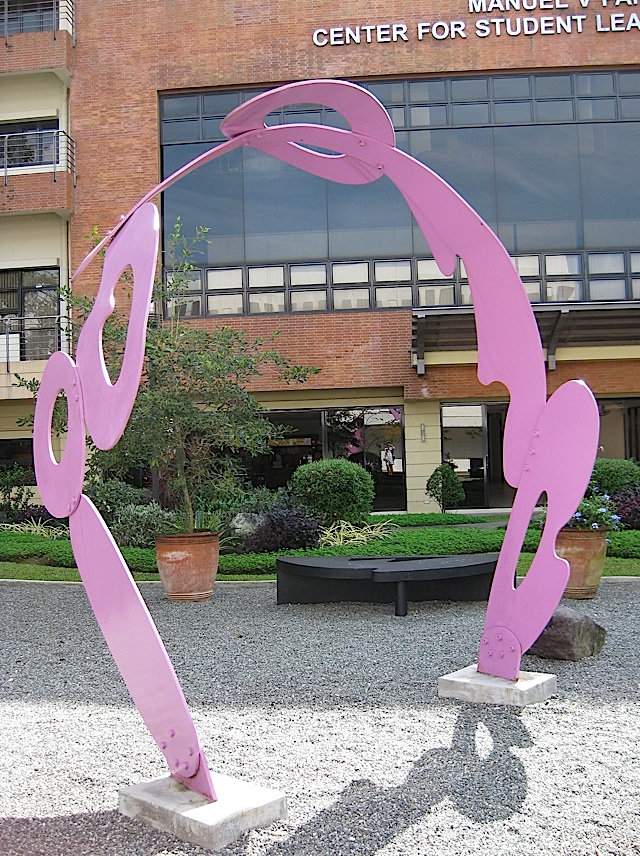
For ten months back in 2008, Filipino artist Impy Pilapil's large, outdoor sculptures for the exhibit titled "Interactive: The 12 Senses" were on display in the gardens of the Ateneo de Manila University. Many of us were very sad when they were dismantled because they added such bright spots of color to the campus. Happily however, two pieces were retained. The bamboo Chime Halo was reinstalled when the new Rizal Library was finished last year and this one, Surge, was never removed. One of the Ateneo Art Gallery curators told me that it weighs a ton, which is probably why the artist decided to keep it in the university.

Impy Pilapil's outdoor sculpture Surge at the Ateneo de Manila University


I'm glad. I think it looks great in the rock garden beside the Manuel V. Pangilinan Center for Student Leadership along my favorite brick path.

Impy Pilapil's outdoor sculpture Surge at the Ateneo de Manila University


Did you see me reflected on the glass window of the first photo? :)
See what's reflecting what at James' Weekend Reflections.
Weekend Reflections

February 24, 2012

Eye candy

Jan Leeroy New's wearable art at the 2012 Art in the Park
Jan Leeroy New, the same artist who draped the Rizal Library Special Collections Building with the creepy, red "Balete," also had an exhibit at the 2012 Art In The Park (see yesterday's post). Aside from his booth, he had two girls walking around the park in his fluorescent plastic "Wearable Art." I can't quite decide whether they look more like flowers or underwater creatures. And no, they aren't for sale.

September 14, 2009

AAA 2009: A tumor and an alien

As I promised last month when I posted a photo of the 2009 Ateneo Art Awards event, I visited the Ateneo Art Gallery where the short-listed pieces are on exhibit until September 19. There are three winners and these are what I will show in the next few days. Among the winners, two of the four art residencies were granted to one young artist, Jan Leeroy New (b. 1986), for his installation at the 2008 Singapore Biennale. Titled "Terratoma II: War of the Worlds," the large tumor-like growths and aliens were fastened onto the Singapore City Hall from September 11 to November 16, 2008. For the current exhibit, only one tumor and one alien were installed on an exterior corner of the Rizal Library, where the gallery is located, but it is still quite startling when one first notices it. And for those of you who, like me, are modern art-challenged, the gallery's notes on New's art installation is below. 2009 ATENEO ART AWARDS SERIES #1 OF 4

Terratoma II: War of the Worlds by Jan Leeroy New

New's Terratoma was exactly that, jutting out like an organic growth on top of Singapore's City Hall during the 2008 Singapore Biennale. To some habitués of this bustling city state, the humongous fiberglass tumor was a stranger sight than the alien figures surrounding it, emanating it seems from the saucer-shaped dome of the building. A shared language is at work here, an unquestioned memory shaped by science fiction and extra-terrestrial fascinations.

Such a figuration of aliens serve an expected prototype, but to this artist, aliens are part of his exploration of hybrid forms where deities and supernatural beings from various cultures meld into curious creatures that nonetheless retain the iconic pose and placements of their origins. The stance paradoxically reconnects us with its intrinsic narratives, the world of myths made tangible and explored anew through accessible industrial-grade materials.

Subject to the play of Biennale tastes and motives, the installation emitted an appealing universality; but further on, the challenge of fastening the work on top of a state edifice takes on enduring themes of justice, heroism and struggle. Science and fiction is a paradoxical mix, but as New opines, this is part of the human exercise of explaining the unexplainable. It is a mythology that continues to contemporary times, just as there will always be constructs to attain the unattainable.

May 1, 2010

An offering

THEME DAY: STATUES • In 1935, the fourth President of University of the Philippines, Rafael Palma, commissioned sculptor and professor Guillermo Tolentino to create a monument based on the second stanza of Philippine National Hero Jose Rizal's "Mi Ultimo Adios" (My Last Farewell) which would be the identifying landmark of the university. The result was the Oblation (noun, something offered in worship or devotion), a naked figure of a young man with face tilted heavenward, eyes closed, arms outstretched, hands open and chest forward—a grand pose of self-offering. The original statue, made of concrete painted to look like bronze, is now kept in the university's main library. The statue in front of Quezon Hall, the administration building, is a bronze replica recast from the original and unveiled in the Diliman campus in 1958.

the Oblation in the University of the Philippines - Diliman

See more statues in the virtual global museum that is City Daily Photo on this first day of May. Click here to view thumbnails for all participants.