Showing posts sorted by relevance for query "ateneo art gallery". Sort by date Show all posts

March 16, 2010

Last look

The small Ateneo Art Gallery holds the distinction of being the first museum in the country dedicated to Philippine modern art. The gallery was established in 1960 when Fernando Zobel de Ayala (b. 1924, d. 1984) gifted the university with a large collection of works by postwar artists. An even smaller room in the gallery always displays selections from the Zobel bequest. The whimsical artwork on the left is a hand-colored lithograph by Lithuanian-born American artist Ben Shahn (b. 1898, d. 1969) from 1952 titled "Boy Eating Ice Cream."

part of the Zobel collection in the Ateneo Art Gallery


Because the gallery is small, very few pieces from its permanent collection—paintings and sculptures—can be displayed. During the few weeks in a year when the larger room does not have a special exhibit, the gallery staff brings out more pieces from the permanent collection to display. The large yellow abstract painting in the back is by Philippine National Artist for the Visual Arts Jose Joya (b. 1931, d. 1995) from 1958 titled "Granadean Arabesque."

Ateneo Art Gallery


Yesterday, March 15, marked the last day of the gallery in the rooms in these photos. Thanks to the construction of the new Rizal Library, the Ateneo Art Gallery is moving into the spacious first floor of the library's old building. I can't wait to see their new space when the renovations are done and they re-open.

September 15, 2009

AAA 2009: A silent ode to Bach

"Death to the Major, Viva Minor" was the opening exhibit at the new Silverlens Lab (SLab) art gallery from October 16 to November 22, 2008. Twelve pieces using various media were created by artist Patricia Eustaquio (b. 1977) for the gallery which used to be the location of a piano school. And it was for this exhibit that Patty was chosen as one of the three winners of the 2009 Ateneo Art Awards. Three of the pieces are in the current exhibit at the Ateneo Art Gallery. Again, the gallery's notes on Patty's exhibit is below. 2009 ATENEO ART AWARDS SERIES #2 OF 4

Arteria Axillaris, ceramic
Arteria Axillaris by Patricia Eustaquio
Untitled (Piano), carved leather and ceramic
Untitled (Piano) by Patricia Eustaquio
Psychogenic Fugue, layers of crochet lace and epoxy
Psychogenic Fugue by Patricia Eustaquio

Dissonance transposes into harmony within the location of a former piano school where SLab's gallery now stands. Eustaquio's suite of works is read as an installation of very different objects united not by a message but by the artist's harmonious manipulation of what constitutes the skin, bone and organs of these crafted objects.

The artist's allusion to Johann Sebastian Bach's The Well-Tempered Clavier, equally a suite of short and progressive piano pieces that utilizes all 24 major and minor keys without perceptively going out of tune, is suggestive of an interest in tempering or harmonizing divides firstly between art and craft, given her practice as both a maker of art and a maker of clothes. She meanders through this discourse through fragments, wholeness and overtures on historicity in works of canvas as well as constructed and found materials.

What she aims to put together is not easily deduced; these are not visual translations of music. The process does not deign to parallel the making of music nor the sensation of music. As Eustaquio admits, she knows nothing about music and it is exactly this ignorance which allows her to experiment freely. Yet the works are evidently studied; there is nothing arbitrary in the play of color, texture and pattern. These are astute works of design, achieving sensuality and quiet elegance while evoking mixed memories and an unfolding of possibilities. Undoubtedly, it is a collection that comes together as a well-composed and thoughtful piece.

September 16, 2009

AAA 2009: Memories of martial law

The third artist who won in the 2009 Ateneo Art Awards is Kiri Dalena, who is also a film-maker, for her installation at the Lopez Memorial Museum's "Keeping the Faith: Acts of Mediation" exhibit from November 13, 2008 to April 4, 2009. Dalena's art installation was titled "Barricade, book of slogans, erased slogans and isolation room" and is her interpretation of the Philippines' martial law years, which she didn't experience because of her young age. Of all the pieces in the current exhibit, I feel that the small portion from Dalena's installation which was transported to the Ateneo Art Gallery does not do her original work justice. In the Lopez Museum, she had an entire room for her installation, which was much more complex than what is in the gallery right now. If you care to understand her original piece more, please read the gallery's notes below. 2009 ATENEO ART AWARDS SERIES #3 OF 4

Barricade, book of slogans, erased slogans and isolation room by Kiri Dalena

Dialogues between archives and contemporary art practice are inevitable as induced tensions. Museums and libraries are repositories of memory and they are appointed as sites for preservation and education , where silence, stasis and stringent controls on tangibility and visibility are imposed. The artist enters this realm and causes a disruption of order. Within this context, installation art offers avenues to liberate memory from reliquary confines.

Dalena embarks on this dialogue by referencing photographs of protests and rallies during the period of Martial Law and adjuncts this to present-day extrajudicial killings. The sentiment is just to be expected. A portrait of state brutality in these past visual journals resonates in the unsolved and unresolved executions and disappearances that the artist deals with in her advocacy work. But this is not simply an emotional confrontation between past and present. Dalena had chosen instead to employ a conscious placement of transcriptions within a setting of school chairs and tables. Read as evidence after the fact, the transcripts are regarded in the texts removed from the photographed placards which have then been transferred into little red books. A pile of chairs recall the barricades built during the First Quarter Storm, of which one arm had been detached and reattached to cradle a copy of the book. Fallen clay bodies are strewn among the rubble, their outlines repeated on the wall. The museum's storage is transformed into an isolation room for one more crouching figure where the texts are again transcribed as a haunting recitation.

The installation sums up what the artist admits to as borrowed memories which she cannot help but manipulate within her own sphere of meanings. By transferring archive into transformative action, Dalena not only opens a renewed awareness of the past. She makes us confront our comfortable tendency to bury history within its silent and stately demarcations.

September 14, 2009

AAA 2009: A tumor and an alien

As I promised last month when I posted a photo of the 2009 Ateneo Art Awards event, I visited the Ateneo Art Gallery where the short-listed pieces are on exhibit until September 19. There are three winners and these are what I will show in the next few days. Among the winners, two of the four art residencies were granted to one young artist, Jan Leeroy New (b. 1986), for his installation at the 2008 Singapore Biennale. Titled "Terratoma II: War of the Worlds," the large tumor-like growths and aliens were fastened onto the Singapore City Hall from September 11 to November 16, 2008. For the current exhibit, only one tumor and one alien were installed on an exterior corner of the Rizal Library, where the gallery is located, but it is still quite startling when one first notices it. And for those of you who, like me, are modern art-challenged, the gallery's notes on New's art installation is below. 2009 ATENEO ART AWARDS SERIES #1 OF 4

Terratoma II: War of the Worlds by Jan Leeroy New

New's Terratoma was exactly that, jutting out like an organic growth on top of Singapore's City Hall during the 2008 Singapore Biennale. To some habitués of this bustling city state, the humongous fiberglass tumor was a stranger sight than the alien figures surrounding it, emanating it seems from the saucer-shaped dome of the building. A shared language is at work here, an unquestioned memory shaped by science fiction and extra-terrestrial fascinations.

Such a figuration of aliens serve an expected prototype, but to this artist, aliens are part of his exploration of hybrid forms where deities and supernatural beings from various cultures meld into curious creatures that nonetheless retain the iconic pose and placements of their origins. The stance paradoxically reconnects us with its intrinsic narratives, the world of myths made tangible and explored anew through accessible industrial-grade materials.

Subject to the play of Biennale tastes and motives, the installation emitted an appealing universality; but further on, the challenge of fastening the work on top of a state edifice takes on enduring themes of justice, heroism and struggle. Science and fiction is a paradoxical mix, but as New opines, this is part of the human exercise of explaining the unexplainable. It is a mythology that continues to contemporary times, just as there will always be constructs to attain the unattainable.

September 17, 2009

AAA 2009: Precious junk

I've already shown you all three winners of the 2009 Ateneo Art Awards in the three previous posts. Now let me show you my favorite out of the twelve short-listed artists. Michelline Syjuco's "Armadillon" was originally exhibited at the gallery of Mag:net Bonifacio High Street from August 8 to October 8, 2008 and the entire piece is currently on display at the Ateneo Art Gallery although in a more compact version. The two winged figures are made out of wood and beaten rusty scrap metal. In the display case are mannequin's hands carrying various kinds of handcrafted jewelry made not only out of precious metals and semiprecious stones, but also ordinary metals and rocks, and even hardware. Michelline caught many of my favorite things in her piece: science fiction and fantasy, earth tones, chunky jewelry, wood, stone, metal and texture—so it's little wonder why I immediately fell in love with it. I've again written the gallery's notes of the artwork below but this was one piece where I didn't need to read the notes to know that I like it.

Armadillon by Michelline Syjuco
The problem with modern art pieces like this (and those of the three winners, actually) is, I can't imagine them outside a gallery or museum. If the artist is willing to break up the parts though, I wouldn't mind having this spiky, rusty winged warrior in our living room. My dear Dogberry just might protest though. 2009 ATENEO ART AWARDS SERIES #4 OF 4

Armadillon by Michelline Syjuco

Design and merchandise are part of the language of function, and they figure prominently in this installation of hand-crafted objects. All pieces are molded or else made for the functions of the body. Or so it seems. Syjuco proceeds to subvert our ideas about functionality foremost by addressing the divide between precious and 'worthless' materials. These are exquisite pieces of jewelry rendered from gold, silver, coral and amethyst, but also common metals, stones, flawed pearls and even hardware materials. What she achieves is design informed by conversation, where the quality of each element is brought out in contrasts and combines of intricate yet hard-edged details. Even rust is employed here, its color adding depth to embossed and beaten metal plates.

Syjuco promotes "Armadillon" as her own imaginary world. It is sheer baroque extravagance recalling the grandeur of churches and church ornaments, but clearly she is most inspired by the production design of epical fantasies, drawing on themes of magic and warriorhood.

What Syjuco attempts in her ornamentation are translations of beauty and danger; avid introspections on material and spiritual flight.

June 19, 2011

Happy birthday, Pepe

Today is the 150th birth anniversary of Philippine National Hero Jose Rizal, and Filipinos all over the world are celebrating it, not just today but throughout the year. Rizal studied in the Ateneo Municipal de Manila, which is now the Ateneo de Manila University, and the school will be commemorating his life and works with exhibits, lectures, books and performances until December. These activities were launched last Friday with the opening of the "Rizal in Ateneo, Ateneo in Rizal" exhibit at the Ateneo Art Gallery curated by foremost Rizal scholar and historian Dr. Ambeth R. Ocampo. This 1930 bust of Jose Rizal at the entrance of the exhibit is by Philippine National Artist for Sculpture Guillermo Tolentino and the background is an image of the ornate entrance of the old Ateneo in Intramuros.

Rizal in Ateneo, Ateneo in Rizal exhibit at the Ateneo Art Gallery

August 11, 2010

Art as activism

Kiri Dalena, here being photographed by Cocoy Sarmenta, is a visual artist and film director.

artist Kiri Dalena being photographed by Cocoy Sarmenta


Her installation Watch History Repeat Itself is on display in the Ateneo Art Gallery until August 16.

Watch History Repeat Itself art installation by Kiri Dalena at the Ateneo Art Gallery


This is not art which is meant to decorate a room to make it pretty. It is art that wants to say something. And in Dalena's case, that something is Philippine political commentary, executed ironically in blinking, commercial neon. Below is an excerpt from the essay "History in Translation" written by film maker and writer Adjani Arumpac, and a video tour of the complete exhibit taken by Manila Art Blogger.
    A blinking white neon sign screaming Liar! Liar! Liar! randomly illuminates a black room, recalling reactions to statements issued by the Gloria Macapagal-Arroyo government—from the infamous Hello Garci controversy to over 1,000 alleged extra-judicial killings throughout its nine-year reign. A red neon sign that floods red light in a white vacant area reads Dear activist, write a slogan for me tenderly invites one to contemplate past and ongoing brutalities denounced by various sectors in countless angry statements against the government. 
    That neon signs, ubiquitous visual polluters and commercial vendors of the modern world, give light to such provoking statements reveals what the artist sees as a paradox—commercial and political interests of the ruling elite are protected by the state through various mechanisms such as brute armed strength. 
    Dalena's aesthetics banks on a pervading sense of terror in real-time, continuing. But this sense of immediacy and urgency, an energy usually taken out in the streets, is forcefully brought to a standstill by the artist. She chooses to show tragedy as history, as clearly advertised by a blinking neon light that spells History. In the same vein, transferred in the Yellow Book of Slogans are rally calls culled from photo-documentation of rallies waged against the nine-year Arroyo regime. Likewise, inscribed in a single funerary slab are the haunting words: Watch History Repeat Itself, an abridged text displayed during Cory Aquino's funeral march. 
    Dalena wrests these texts out of the streets and entombs them in forms and mediums that significantly depart from traditional protest art, wherein prime is given to fast production, accessibility and portability, whose end is to provide visual support for street mobilizations. She doubly gives weight to her cause, literally, by trading permanence for transience through writing ephemeral protest call in black and white and in stone.

August 18, 2009

The Next Wave

It is only the sixth year of the Ateneo Art Awards and it is quickly growing into a much-coveted award by Filipino artists 35-years-old and younger. From granting just one art residency in Australia, it now grants four with the addition of programs in Indonesia, Singapore and New York. The exhibit and awarding ceremony venues are always high-profile, which is one reason why it has been very successful. The first four years, it was at the Power Plant Mall in Makati City. In 2008 and this year, it was at the Shangri-la Plaza Mall in Mandaluyong City. I finally decided to satisfy my curiosity and attended last week's ceremony for the 2009 awards. I took this from a higher floor quite early when people were just starting to arrive for the cocktails. Two hours later, the cordoned-off area was jam-packed with artists and society people and one could hardly move around, much less appreciate the artwork. When the exhibit moves to the more peaceful Ateneo Art Gallery, I'll try to visit and take pictures of the winning pieces, but in the meantime, photos of the twelve in the short list are here.

Ateneo Art Awards 2009

September 4, 2010

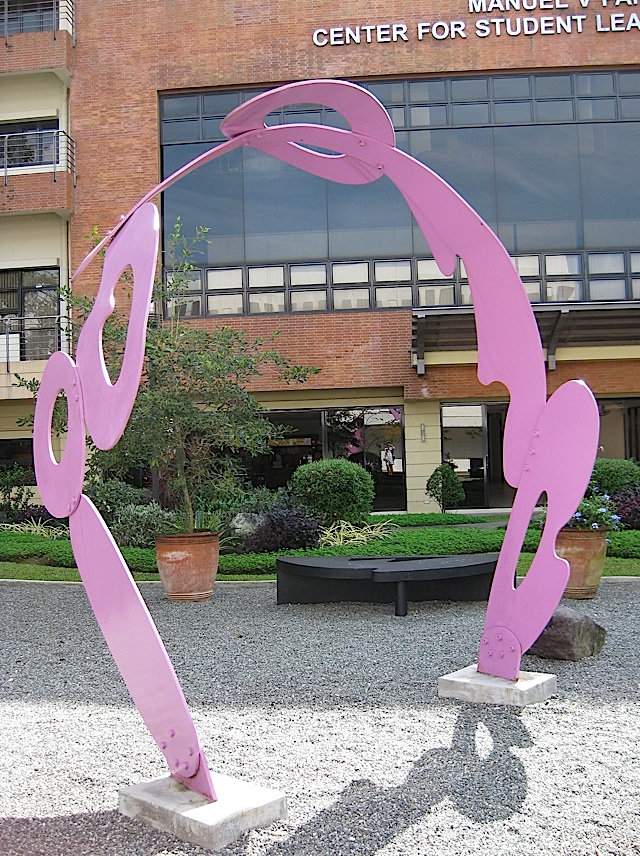
Pink behemoth

For ten months back in 2008, Filipino artist Impy Pilapil's large, outdoor sculptures for the exhibit titled "Interactive: The 12 Senses" were on display in the gardens of the Ateneo de Manila University. Many of us were very sad when they were dismantled because they added such bright spots of color to the campus. Happily however, two pieces were retained. The bamboo Chime Halo was reinstalled when the new Rizal Library was finished last year and this one, Surge, was never removed. One of the Ateneo Art Gallery curators told me that it weighs a ton, which is probably why the artist decided to keep it in the university.

Impy Pilapil's outdoor sculpture Surge at the Ateneo de Manila University


I'm glad. I think it looks great in the rock garden beside the Manuel V. Pangilinan Center for Student Leadership along my favorite brick path.

Impy Pilapil's outdoor sculpture Surge at the Ateneo de Manila University


Did you see me reflected on the glass window of the first photo? :)
See what's reflecting what at James' Weekend Reflections.
Weekend Reflections

June 3, 2008

Aussie art exhibit

The reason why I was able to see the new Australian ambassador was because of Under my skin, a touring exhibition featuring five Australian artists: Emil Goh, David Griggs, Pat Hoffie, Megan Keating and Louise Paramor. They are participants of the University of Melbourne's Asialink, an arts residency program which enables Australian artists to live and work in different Asian cities. The host gallery for the Philippine exhibition is the Ateneo Art Gallery. Here we see guests and visitors chatting away just before the opening, waiting for the ambassador to arrive.

Under my skin, Asialink touring exhibition

June 20, 2011

Farewell

Of all the mementos and historical artifacts in the "Rizal in Ateneo, Ateneo in Rizal" exhibit (see yesterday's post), this small, unassuming alcohol burner caught my fancy the most. The day before his execution on December 30, 1896, Jose Rizal was visited in prison by his mother, sisters and nephews and he whispered to his sister Trinidad that there was something hidden inside the burner. When it was given to his family, they discovered a folded piece of paper on which a poem was handwritten by Rizal. Untitled and unsigned, it is known popularly as "Mi Ultimo Adios" (My Last Farewell). The images in the background are of a replica of Rizal's prison cell inside the Rizal Shrine in Fort Santiago, Intramuros. The alcohol burner is on loan to the Ateneo Art Gallery from the family of Estanislao Herbosa, a nephew of Jose Rizal from his sister Lucia.

alcohol burner where Jose Rizal's Mi Ultimo Adios was found

For those interested in reading the poem, here are a few links:

September 27, 2010

Artificial wings

This is the introductory piece of Filipino-German artist Kawayan de Guia's exhibit titled "Bored on the Fourth of July." He was the recipient of the 2008 New York Art Project residency grant which is selected annually by the Omi International Arts Center. "Bored on the Fourth of July" was shown in the Ateneo Art Gallery last year but I forgot to post it back then and just saw it again yesterday when I was cleaning up my iPhoto. From the exhibit notes:
    In two sets of images and texts, Kawayan puts forward a critique and commentary on the human propensity to consume that he witnessed in America and rediscovered on his return home. It is a propensity, a hollow greed that America projects on the world. In this world, shopping is the new drug; the source of fleeting mass-produced moments of happiness and artificial healing.

neon wings in Kawayan de Guia's exhibit titled 'Bored on the Fourth of July'

February 2, 2010

Death mask

"Louis" of San Francisco Bay Daily Photo correctly guessed who the bust in front of yesterday's narra screen was: St. Ignatius of Loyola (Spanish, 1491–1556), the founder of the Society of Jesus. What pleased me too was the gut reaction of Julie of Sydney Eye ("It looks like a death mask!") because in a way, she was correct too. The bust is bronze and cast by Filipino sculptor and SF Bay resident Earl E. Enriquez from the death mask of Ignatius; or if you want to be precise, from a plaster cast made from his death mask which is kept in the Jesuit archives in Rome. I agree with Mike Rose and Chuck Pefley that the pedestal supporting the bust is not a great choice, but what is intriguing about it is that the height of the pedestal with the bust represents the actual height of Ignatius. Based on the dimensions of his death mask, and a surviving soutane and pair of shoes, it is estimated that San Ignacio de Loyola was 5 feet and 3 inches (160 cm). The bust and screen are part of the "Faces of the Ateneo" exhibit, one of four special exhibits of the Ateneo Art Gallery for its 50th anniversary, running until March 15.

bronze bust of St. Ignatius of Loyola

January 29, 2009

Going nowhere

I took this photo early last year but didn't want to post it then because I hadn't yet posted a photo of our ubiquitous jeepney, which plays a large part in the painting. Since I finally have, one in November and one in December, I can finally post it. Titled "Jack en Poy," this oil painting by Filipino artist Alfredo Esquillo Jr. was part of the 2008 "Tutok Kargado" exhibit of the Ateneo Art Gallery. The exhibit had a decidedly political flavor, and this piece exemplifies it. "Isang dyip tayo," the text on the ribbon, literally means "we are one jeepney." "Dito–doon" is "here–there." Cockfighting is a popular Filipino betting sport and roosters are a common jeepney hood ornament. "Jack en Poy" is what we call the paper-scissors-rock game—notice the balloons—because of the rhyme we recite when we play it. The rhyme ends with the line "he who loses is the monkey." I think this painting is a great commentary on Philippine society and politics. Guess who loses.

Jack en Poy, an oil painting by Alfredo Esquillo Jr.

February 25, 2010

Same old, same old

Krista by Pablo Baen Santos, 1984, oil on canvas. One of the pieces in the social realist collection of the Ateneo Art Gallery currently on display in the exhibit "Fractions of an Intangible Whole." From the exhibit notes:
    This work depicts inang bayan (Philippine motherland) with a crown of barbed wire around her mouth like a gag. The work simultaneously embraces the themes of nationalism, censorship and the strong influence of the Catholic tradition in the Philippines. The Philippine flag and a sea of protesting bodies forge the backdrop as the female Christ holds her clenched fist in defiance.

Krista by Pablo Baen Santos
One year shy of the silver anniversary of the 1986 EDSA People Power Revolution, not much has changed in Philippine politics. In many ways, it is even worse than during Marcos' time. Corruption is rampant and has filtered down to all levels of government, public education is a joke, poverty levels have not improved, environmental degradation is uncontrolled, and journalists still fear for their lives. Even if we manage to elect an ethical president in May, there will not be much to celebrate during the revolution's silver anniversary. It will take much, much longer than a year to apply breaks to the downward spiral that our country has gotten itself into since that historic moment.

July 22, 2010

Rooted

Last year, it was an alien on a tumor. This year, the building of the Ateneo Art Gallery is crawling with Jan Leeroy New's "Balete."

Balete by Jan Leeroy New


The balete or banyan tree figures prominently in Philippine mythology as the favored home of spirits, especially the malevolent and evil kind. A portion of the exhibit notes reads:
    Who's afraid of the Balete? Also called the Banyan tree, the Balete's distinct aerial prop roots and capacity to grow to huge proportions have bestowed upon the tree a sacred identity. Most dare not trespass this mysterious entity. Nevertheless, Leeroy New goes ahead to recreate the awe and terror that it inspires, using bright orange flexible conduits for electric cables as probing roots that attach to and choke pristine white pillars.

Balete by Jan Leeroy New


All I can say is, I refuse to walk down my favorite brick road at night while the exhibit is ongoing (until October 2 or as long as the plastic tubes last, whichever comes first).

Balete by Jan Leeroy New

July 7, 2013

The Family

glass sculpture by Ramon Orlina This small glass sculpture by Ramon Orlina has always been one of my favorite pieces in the collection of the Ateneo Art Gallery. Orlina shapes his sculptures from blocks of industrial glass, hence the green coloration of most of his work. An architect by training, Orlina began exploring sculpture during the turbulent 1970s when his clients started moving to the U.S. because of the Marcos dictatorship. Completely self-taught in glass sculpture, Orlina has since won numerous international awards for his work, and was declared The Outstanding Filipino (TOFIL) Awardee for the Arts in 2006.

April 17, 2010

Behind bars

The Door by Conrado Mercado, aluminum and brass relief, 152 x 203 cm, 1973. Even back in my college days, this was one of my favorite social realist pieces from the Ateneo Art Gallery. Very powerful. And painful.

The Door by Conrado Mercado

September 18, 2009

For my soul

After spending almost the entire week indoors at the Ateneo Art Gallery looking at some very strange artwork, let's step outdoors for a breather, shall we? Just another beautiful day looking at the boats docked at the Manila Yacht Club. This photo is from the archives. After three weeks of almost constant rain, my soul is yearning for some bright blue skies.

a bright, blue day at the Manila Yacht Club

Visit the Sky Watch Friday home page and tour the skies of our beautiful world.
Sky Watch Friday