Showing posts with label poor. Show all posts

June 17, 2014

Team building

Our office trip to Bantayan Island (see yesterday's post) wasn't only for rest and recreation. The more important objective was team building. In our case, it was quite literal.
 GK Village in Bantayan Island Gawad Kalinga (GK), which means "to give care," is a poverty-alleviation and nation-building movement which builds houses and creates communities all over the Philippines for the poorest Filipinos. GK communities are known for their colorful houses, which is but the first step in the long process of poverty-alleviation. There is a young GK Village in Bantayan Island—named the Pope Francis GK Village—and we spent our first afternoon there.
 GK Village in Bantayan Island GK is completely funded by donations and powered by volunteers. The land for the Pope Francis GK Village was donated by the municipality, which increased the donation after Typhoon Haiyan destroyed many of the coastal villages in Bantayan Island. The houses are largely funded by Xavier School and the ERDA Group, both Jesuit institutions based in Manila.
   GK Village in Bantayan Island The simplest way of volunteering is by helping build houses, which is what we did. The boys did the heavy work of mixing the sand, cement and water. (I tried, but my arm strength is absolutely pathetic.) That's our big boss dude in the Hawaiian shirt.
 GK Village in Bantayan Island We passed buckets of the cement mixture for the floor of one of the units. Aside from volunteers, GK houses are built by their recipients, who have to log in 300 hours of labor and attendance in values formation workshops before they can move in. GK calls it "sweat equity." And the formation continues long after the beneficiaries receive their houses—necessary if one wants to build real communities and not just houses.  
 GK Village in Bantayan Island Before we left, some of the children of Pope Francis GK Village performed a dance for us, a dance that they had been practicing for a big GK event.

To learn more about Gawad Kalinga, and maybe even donate or volunteer, please visit their website.

April 14, 2013

Balloon lady

lady selling balloons at the Immaculate Heart of Mary Parish church The lady selling balloons just outside the Immaculate Heart of Mary Parish church was nice enough to pose for me when she saw me trying to take her photo. Business must be good during Sundays, when entire families attend Masses at the church, but I hope she also does well during weekdays.


I apologize for my sudden disappearance again. We had internet connection problems the entire week! Everything's okay now, thank goodness.

April 3, 2013

Games (street) children play

board game on the sidewalk using bottle caps What looks like a checkers-like game with the board marked on the sidewalk and bottle caps as playing pieces. It was beside a restaurant, so it is probably played by watch-your-car-boys. Unfortunately, there is a big possibility that gambling is involved. Smoking definitely is.

March 1, 2013

Red plastic

carinderia CITY DAILY PHOTO THEME DAY: CAFE CHAIRS • Nothing pretty today, just some of those uncomfortable plastic monobloc chairs. At least they're a cheery, cherry red, and not the plain white ones that get so dirty-looking after only a few weeks. Metro Manila has lots of these tiny, streetside eateries which we call carinderia or turo-turo (from turo, to point, because that's all you have to do to tell the server what you want to eat), especially around public transportation terminals, whether for taxis, buses, jeepneys or tricycles. Obviously, you won't find them in posh neighborhoods.

December 20, 2012

Orange

row of water meters in a metal cage Near the entrance of an alley which leads to a poor community, the water meters of a row of apartments are locked in a metal cage whose base is cemented into the ground. The cage helps prevent three things: coconuts falling on and damaging the exposed pipes, illegal tapping into the water line, and stealing of the steel meters for resale.

December 6, 2012

Of smiles and hearts

the Quezon City Sikap Buhay stall at the Blue Market social enterprise fair At the Blue Market social enterprise fair where I took yesterday's photo, I was immensely gratified to learn about Quezon City's Sikap Buhay Entrepreneurship and Cooperatives Office. More than just a microfinance program, the office helps its poor clients with business development and planning, and it also helps the micro enterprises find new customers and markets. In fact, their stall in the fair featured the handicrafts of several cooperatives and enterprises, which included bags, mats and picture frames woven from fabric scraps, used paper and foil packs. Less garbage for the city, livelihood for the city's poor, and useful products for their customers. Everyone wins.

December 5, 2012

Snack bags

bags made out of foil packsWould you believe that these woven bags are made of those plastic and aluminum foil packs that potato chips and their ilk come in? Several years ago, someone realized their potential for a livelihood project for the residents of Metro Manila's slums, especially those near garbage dump sites where used packs can be salvaged from. Habi (weave) Bags are made by the residents of Baseco, a huge island ghetto where the Pasig River flows into Manila Bay. The enterprise has the support of Oishi, a local (despite its Japanese name) manufacturer of snacks and drinks, which provides the weavers with damaged and scrap materials for their colorful and amazingly sturdy bags.

May 18, 2011

Mind the gap

Not all of the kalesas remaining in Metro Manila are for tourist use only. Some districts of the City of Manila still allow them as public transportation, most notably in Binondo, Manila's Chinatown. In fact, one must take care when walking in its streets—look where you're stepping!

a kalesa in Binondo


Unfortunately, just like our people, the horses also suffer terribly from the effects of poverty.

a kalesa in Binondo

October 25, 2010

Ironic

Swatch installed a gigantic watch in Rizal Park commemorating the accession of Benigno Aquino III to the presidency of the Philippines in June of this year. Since his nickname is Noynoy, his presidential nickname has become P-Noy, which is a play on Pinoy, the colloquial term which we use for ourselves as Filipinos. The text written on top of the watch is "Oras P-Noy, Oras ng Pagbabago"—Time for P-Noy, Time for Change.

large P-Noy Swatch watch in Rizal Park

September 16, 2010

Pinkwashing

When Bayani Fernando was the chairman of the Metropolitan Manila Development Authority (MMDA), he had the facades of the squatter areas fronting major highways painted these hideous shades of pink and blue, a color combination which he also used for many of the metro's footbridges. Pink happens to be the favorite color of his wife, former Marikina City Mayor Marides Fernando. Bayani himself used to be the mayor of Marikina too, and the color was first used extensively in that city. I wonder if the new MMDA chairman, Francis Tolentino, will bother repainting the shanties and footbridges, and what color he'll choose. And in case you're wondering what the wire fence is, they're used to block pedestrians from crossing highways.

squatter homes painted pink and blue

May 29, 2010

Poverty gap

A cousin who has lived in Chicago since he was four years old recently came to the Philippines to visit and he told me that one of the things he noticed about Metro Manila was the great disparity between the rich and the poor here. Which reminded me of this photo I took last year and meant to use for the October 2009 CDP theme day, Contrast. I ended up not using it because I thought it was too depressing to use for theme day and also because we had just been devastated by typhoon Ketsana, known locally as Ondoy, and I wanted to post something about it. But my cousin is right. All big cities everywhere have to struggle with the problems of homelessness, but nowhere is the poverty gap more evident than in the megalopolises of third world countries, where luxurious modern skyscrapers stand side by side with sprawling slums and shanty towns. I did not see which Filipino fashion designer owns this atelier, but it is in front of Penguin Café Gallery in the City of Manila.

homeless person sleeping in front of a fashion designer's atelier

March 30, 2010

What would you have done?

Aside from the motorized tricycle, another way of going short distances in Metro Manila is the pedicab, a bicycle with a customized side car for passengers. I was going to a place where I've never been to before and the barangay tanod (village law enforcer) I asked directions from told me that it was quite far and suggested that I take a pedicab. Aside from the fact that the place turned out to be only about 300 meters away, I felt sorry for the poor man who was huffing and puffing by the time we got there (the road was on an incline and I am heavier than a sack of rice). Needless to say, I walked on my way back, but the thought that I deprived someone of the fare I would have paid does not sit well with me either.

a view of the road from inside a pedicab

May 14, 2009

On to the next car

At an intersection in front of the golf course inside the Veterans Memorial Medical Center compound in Quezon City, a lady was selling rags made out of fabric scraps and some kids were begging. The car's windows remained determinedly closed, which means she didn't sell any and the kids didn't get a single centavo. This intersection is very near the large squatter community I showed you last month and this scene is quite common all over Metro Manila.

lady selling rags and kids begging

April 29, 2009

Reality check

Yesterday, Jacob and Per Stromsjo asked why it was necessary for homes in Metro Manila to have privacy walls: are they for privacy, robbers, or both? The answer, of course, is both. I'll explain the privacy aspect some other time when I have a photo that can best illustrate it. Let's just say that it's a reaction against certain Filipino cultural traits. However, this photo will explain why there is a fear of robbery, whether in the home or while walking in the streets, even in broad daylight, and why houses have privacy walls and subdivisions have guarded gates. It also explains why Filipinos tend to carry their backpacks in front, turning them into chestpacks, even when they're traveling abroad. No excuses, no opinions, no solutions—just the facts. According to the 2006 Poverty Statistics report (the latest currently available) of the Philippine National Statistical Coordination Board, 32.9% of Filipinos are poor. Who are the poor? "Those that cannot afford in a sustained manner to provide their basic needs of food, health, education, housing and other amenities of life." According to the same report, 14.6% are "subsistence poor" which means that they cannot even afford "basic food needs, which satisfies the nutritional requirements for economically necessary and socially desirable physical activities." So what are you seeing in the photo? In the foreground is the open parking lot of an upscale mall and the fancy roof of its connecting escalator and path. The wide, white expanse is the paved lot of some demolished building which is being used as a parking lot for trucks and cement mixers. And just beyond the concrete, a sprawling poor community squatting on government land. However painful it is to admit, I don't think there is any barangay in Metro Manila that doesn't have an urban poor community, whether they're 'informal settlers' or not. Yesterday, Boise Diva also wished for us that privacy walls will become unneeded. I wish the same but it will take a lot of hard work and much, much better men and women in our government than we currently have. But I haven't given up hope.

large urban poor community beside an upscale mall

January 22, 2009

Shopping in traffic

This was a lucky shot. I was actually trying to take a picture of Trinoma mall through the car windshield when this street vendor walked towards us. Anyone need a car seat back support? How about a hat? A bobblehead horse? I think the guy behind him is selling hand towels. Many vendors brave the cars of Metro Manila's streets to earn a living, and they sell all sorts of stuff. I get quilted rag rugs for the kitchen from them and my husband is a regular buyer of flannel cleaning cloths.

street vendor

December 4, 2008

Fascination

One of the Up with People participants at the Lights for Hope Christmas outreach party. Most of these kids have never seen a blonde before. I think the little girl's in love.

Up with People student in the Lights for Hope Christmas outreach party

December 3, 2008

Everyone smiles in the same language

Meet some of the children during the Lights for Hope Christmas party. They are from the Leodegario Victorino Elementary School in Marikina City. As public elementary schools go, it's pretty well-off—the teacher-student ratio is about 1:44. I've heard of other public grade schools where the ratio is twice that! I think you may have guessed by now that our public school system is pretty bad, especially in the basic education levels. Meet Dave and Lari too. Dave Penny, the guy with the dimple on his chin, is with Up with People, an organization that started as a performing troupe in 1965 and now offers a six-month global education program which entails international travel, cultural immersion, leadership training and community service for young adults aged 18–29. Lari Sayo, the girl with the dimple on her cheek, is one of the organization's liaisons here in Metro Manila. A small group of the hundred participants were at the party, mingling with the kids and even joining some of the games. I don't know if the Up with People students are still here in Manila, but I hope they enjoyed their visit and learned much.

Up with People participants with children from the Leodegario Victorino Elementary School

December 2, 2008

One afternoon of joy

Enough lessons about the Philippines for now! We're going back to my little corner of the world today. Many student organizations in the Ateneo de Manila University are involved with poor communities and public schools—as tutors and catechists, in building houses and repairing classrooms, or in entertaining and providing companionship to terminally ill children. Every year, our office organizes the Lights for Hope Christmas party for these poor children, many of whom would never experience an afternoon like it otherwise. They are fetched by buses and jeepneys from their schools or communities and brought to a large field in the Ateneo where they have games with prizes, have a heavy snack, enjoy the inflatable slides and go home with heavily-laden goody bags—toys, chips and candies, yes, but also more practical items like underwear, shampoo and toothpaste. In past years, the number of children have been in the 300–500 range. This year, there were one thousand! (Alright, about 980—I saw the unclaimed hotdog sandwiches.) This wouldn't have been possible without the generosity of so many people and the fantastic coordinating skills of Lara. Thank you, everyone! Next year, we hope to gather 1500 children.

Lights for Hope Christmas outreach program 2008

Some of the comments in my post yesterday has gotten me curious: How frequently does your country mint new coins and recall old ones?

October 25, 2008

An early Christmas

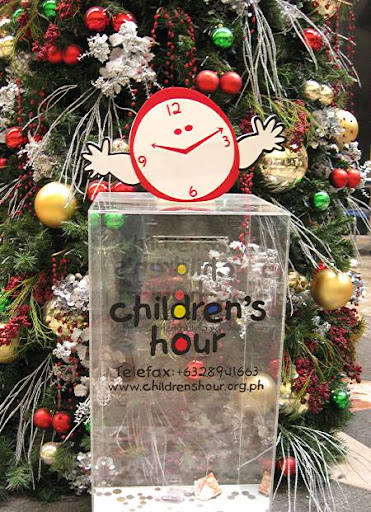
The minute the 'ber' months come around, Metro Manila begins celebrating Christmas. Malls get dressed up with Christmas trees, lights and ornaments, shops display their Christmas merchandise, and everywhere you go and whatever mode of public transportation you take, cheesy pop Christmas songs blare out from speakers both mono and stereo. Personally, I don't mind the decorations, but I hate the music—and that's all I'll say about it. Anyway, there is something about our early and long Christmas season that I approve of wholeheartedly: the various projects meant to help the poor. Some are short-term, Christmas-only projects. I remember a toy shop which asked its customers to buy one extra toy to give to a child in an orphanage, which the shop would match with another toy of the same value. Then there are the long-term projects which use Christmas to try to raise both awareness and more funds, taking advantage of people's generosity (or guilt) during this season. The Children's Hour falls into the latter category. It is a fund-raising, non-profit organization which is trying to convince corporations, employees and individuals to donate at least one hour of their earnings once a year to help poor Filipino children. Now that's easy enough to do, right? The organization does not have its own projects—it gives grants to other organizations which help children. That makes a lot of sense, if you stop and think about it. The Children's Hour has a special emphasis on education and literacy, though feeding and health programs are also supported. After all, how can a child study when all he can think of is how hungry he is? I hope this box—and many others like it all over the Ayala Malls—gets filled by the end of our Christmas season on January 6, the Feast of the Epiphany.

donation box for The Children's Hour

My sister and her three young daughters are arriving tonight for a one-week visit. Wheeeee! I will still try to post a photo everyday, but I hope you will all understand if I don't get to visit much this week. I want to spend as much time as I can with my four girls. Looks like I'm also celebrating Christmas early this year.

October 4, 2008

My Manila

There is a reason why I titled my blog "My Manila" and never changed it even after it was accepted into the City Daily Photo community. Metro Manila is composed of 17 cities and municipalities, after all, and I move in only a tiny part of it. And I mean that in both the geographical sense and, much as I hate to admit it, also in an economic sense. The World Bank estimates that 40% of Filipinos live in poverty. And if the World Fact Book's July 2008 population estimate is correct, that's a whopping 38.4 million people! In Metro Manila, the hard fact of poverty can be seen in large squatter communities, homeless people sleeping under bridges and in parking lots at night, and men, women and children selling flowers, candies, cigarettes and rag rugs on the streets. Unfortunately (or fortunately, depending on your point of view), these are things I have had no opportunity to take pictures of—for various reasons which will take too long to explain—though I know I have hinted at it several times already. Here, finally, is more than a hint: a man rooting through garbage bags to get boxes, cans and bottles that he can sell to a recycling center. I wonder if he even makes 40 pesos a day doing this…

man rooting through garbage bags