Showing posts with label homes. Show all posts

June 17, 2014

Team building

Our office trip to Bantayan Island (see yesterday's post) wasn't only for rest and recreation. The more important objective was team building. In our case, it was quite literal.
 GK Village in Bantayan Island Gawad Kalinga (GK), which means "to give care," is a poverty-alleviation and nation-building movement which builds houses and creates communities all over the Philippines for the poorest Filipinos. GK communities are known for their colorful houses, which is but the first step in the long process of poverty-alleviation. There is a young GK Village in Bantayan Island—named the Pope Francis GK Village—and we spent our first afternoon there.
 GK Village in Bantayan Island GK is completely funded by donations and powered by volunteers. The land for the Pope Francis GK Village was donated by the municipality, which increased the donation after Typhoon Haiyan destroyed many of the coastal villages in Bantayan Island. The houses are largely funded by Xavier School and the ERDA Group, both Jesuit institutions based in Manila.
   GK Village in Bantayan Island The simplest way of volunteering is by helping build houses, which is what we did. The boys did the heavy work of mixing the sand, cement and water. (I tried, but my arm strength is absolutely pathetic.) That's our big boss dude in the Hawaiian shirt.
 GK Village in Bantayan Island We passed buckets of the cement mixture for the floor of one of the units. Aside from volunteers, GK houses are built by their recipients, who have to log in 300 hours of labor and attendance in values formation workshops before they can move in. GK calls it "sweat equity." And the formation continues long after the beneficiaries receive their houses—necessary if one wants to build real communities and not just houses.  
 GK Village in Bantayan Island Before we left, some of the children of Pope Francis GK Village performed a dance for us, a dance that they had been practicing for a big GK event.

To learn more about Gawad Kalinga, and maybe even donate or volunteer, please visit their website.

May 17, 2013

Building blocks

brick walk at Eastwood Mall One of the brick walks of Eastwood Central Park, flanked by the colorful Eastwood Mall and the 1800 Building (an office building), leads to the Excelsior (a residential condominium building) across the street.

May 14, 2013

Is it or isn't it?

Infant Jesus Kindergarten School For as long as I can remember, this was the location of the Infant Jesus Kindergarten School. There is no longer any sign, so I assumed that it is no longer here. But a Google search for the school still points to this address (or one in Hamilton, Ontario), so I'm in a bit of a quandary. Maybe I should ask my husband to walk there during a school day when he doesn't have a class to help me satisfy my curiosity.

April 26, 2013

The Diliman Jungle

broken concrete animals When these concrete animals appeared in front of a house in our neighborhood back in 1974, all the children—me included—were absolutely delighted. None of us thought they were kitschy at all. Almost 40 years later, they're still around, but the elephant has lost its trunk, the horse has a damaged tummy, and the lion's mane has started falling off. The poor things.

March 6, 2013

Gone

foundation of a demolished house Back in January, I posted a photo of the overgrown yard of a house across ours that had stood empty for more than a year. A week after that post, the new owner began the demolishing of the house. It's gone now, and the only thing left is the foundation. And a lot of debris.

I dedicate this post to childhood friends who used to live with their aunt in the now demolished house, and who studied in the same elementary and high school my sister and I did. We spent many happy days playing in their house and garden.

February 24, 2013

BKK: The story of Thai silk

One of the places we visited in Bangkok last November was the Jim Thompson House. James Harrison Wilson Thompson was an American soldier who settled in Bangkok after World War II. He is credited for almost single-handedly reviving the silk industry in Thailand by creating an international market for it and improving the quality of the handcrafted silk. After 22 years in Thailand, in 1967, he and some friends went to the Cameron Highlands in Malaysia for a holiday; he went out for a walk and never returned. Up to this day, no one knows what happened to him.
 the Jim Thompson House in Bangkok, Thailand The Jim Thompson House, now a museum, is made up of six traditional Thai houses which were put together into a single house with a Western floor plan. The red color of the house comes from a natural preservative painted on the teak wood.
 silkworms at the Jim Thompson House in Bangkok, Thailand The silk process begins with these squirming silkworms, the larva or caterpillar stage of the domesticated Bombyx mori.
 cocoons at the Jim Thompson House in Bangkok, Thailand After eating pounds of mulberry leaves and molting several times, silkworms enter the pupa stage and wrap themselves in a cocoon made of raw silk.
 cocoons being boiled at the Jim Thompson House in Bangkok, Thailand The cocoons are boiled to make the silk easier to unravel. Of course, the heat also kills the silkworm inside the cocoon.
 raw silk being spun on a reel at the Jim Thompson House in Bangkok, Thailand The unraveled, raw silk being spun on a reel. Vegetable dyes were traditionally used to color silk, but the results were not consistent and the colors fade after many washings. Jim Thompson introduced modern, color-fast dyes and processes to Thailand in the late 1940s.
 a wooden loom at the Jim Thompson House in Bangkok, Thailand A traditional, wooden weaving loom loaded with red and white silk thread.
 the spirit house in the garden at the Jim Thompson House in Bangkok, Thailand Like all Thai houses and buildings, the Jim Thompson House also has a spirit house at a corner of the property—in the garden and overlooking the canal. The complex also has a restaurant which serves fantastic Thai dishes, and a shop with some of the loveliest silk scarves, ties, and clothes that I have ever seen and touched.

February 23, 2013

And stay out!

textured concrete house with faux tile roof Similar in style to the house yesterday, and probably built around the same period, this house caught my eye because of the varied yet neatly-planted shrubs in its frontage, and the castle-like stone accent at the corner. Even the small windows remind me of arrow slits in fortifications. What look like tiles on the roof are actually pre-painted galvanized iron sheets, which are more affordable and easier to maintain than real tiles. Almost all houses in Manila (in all urban areas in the Philippines, actually) are walled and gated—with a big gate for cars, and a smaller one for people. The pedestrian gate is usually where the door bell is located, and some, like this one, have a mailbox built in.

February 22, 2013

Textures

textured concrete and brick house The textured, unpainted concrete used on this house is typical of buildings in Metro Manila constructed during the 1970s, but I like the addition of brick accents, and the iron and wood gates. Vine-covered stone privacy walls can still be found in many upper-middle-class neighborhoods.

January 29, 2013

Pocket jungle

overgrown yard The house across ours has been empty for about half a year now. It was supposedly bought by a developer who was going to build row houses, but nothing has been done yet and we have not even seen a shadow of the new owner. In the meantime, the trees, vines and grass have so grown unchecked that the house can hardly be seen anymore.

By great luck, one of our barangay security was walking down the street when I was taking this photo. I guess that was only when he took a hard look at the state of the property, because the next day, there was a small army of barangay ecoworkers mowing the grass and trimming the trees.

January 6, 2013

Bamboo

bamboo hut In the Philippines' rural areas, bamboo huts are still widely used for homes. Traditionally, the roof is made of nipa palm leaves. Though the roof of this one has been replaced with corrugated iron sheets, it still sports a small fringe of nipa under the peak. The raised floor, which is also made of bamboo, has many uses: it helps with air circulation and cooling; when it rains and the ground outside turns to mud, it prevents the mud from seeping into the house; and the sheltered space underneath is also where the family's animals (especially dogs and chickens) can sleep at night. This hut was along the Pan-Philippine Highway somewhere between the towns of Pagudpud and Burgos in Ilocos Norte. Not quite so remote—they're on the power grid.

December 1, 2012

Mango fruit with leaves

one of our neighbors CITY DAILY PHOTO THEME DAY: MY STREET • This used to be quite a lovely clapboard house when I was younger. Then the original owners immigrated to the U.S. and the couple who bought it went into politics. That meant bodyguards and more rooms to accommodate them, so they built over the garage, and this was the result. The family has since moved to a more upscale, gated neighborhood where, last time I saw it, their new fortress is painted these same colors.

November 22, 2012

Stand out

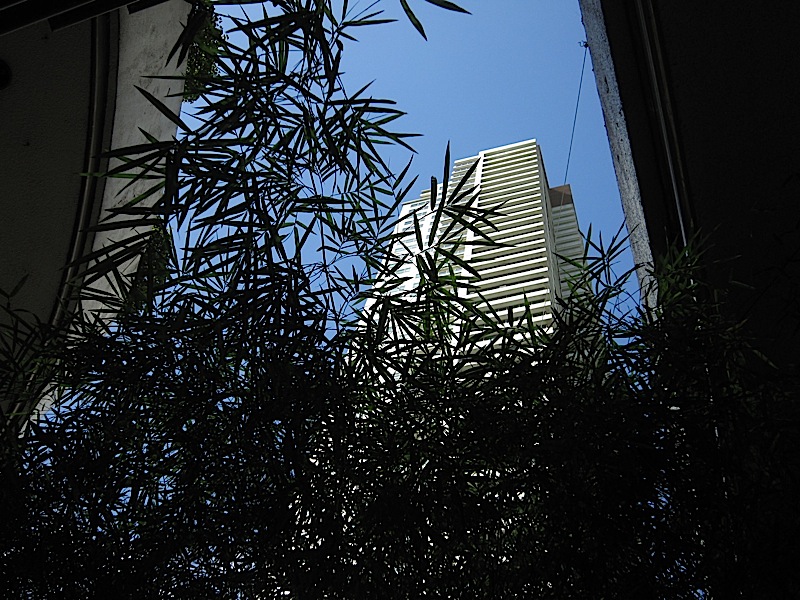
The Residences at Greenbelt One of the towers of The Residences at Greenbelt, highrise residential condominiums integrated with Ayala Land's shopping and dining center, taken from under the canopy of the much smaller building across the street.

November 21, 2012

में आपका स्वागत है

foyer of the house of an Indian family in Manila In my limited sphere in a tiny corner of the world, I do not often get to visit the homes of other nationals living in Manila. This is the foyer of the home of an Indian family that has been based here for a couple of decades.

I sure hope I copied the correct Hindu welcome greeting from Google Translate.

June 4, 2012

Family history

From May 12 to 24, my husband and I went on a road trip through the Central Luzon and Ilocos Regions, stopping at cities and towns that we've never visited before. My Manila goes outside Metro Manila for the next few days. I hope you enjoy the trip.


ruins of the Litonjua house in BacnotanMy husband and I spent two days in the province of La Union. One of the reasons for that was personal—he wanted to visit the town of Bacnotan, where his mother's family originally was from. He remembers visiting Bacnotan, 243 kilometers northwest of Metro Manila, a few times when he and his siblings were little children and just walking to the beach from the house. We found the house thanks to a map that his mother had drawn for him. Sadly, it is in a very bad state.


ruins of the Litonjua house in Bacnotan All but one of my mother-in-law's family moved to Metro Manila or the U.S. a long time ago and the brother who stayed behind passed away several years ago. Since then, no one has taken care of the property. In the spacious yard, we saw the well where, my husband recalls, their bath water was drawn from.


Bacnotan town hall After visiting the house, we decided to walk around the vicinity and discovered that the town hall was just a few blocks away. A very young-looking town hall, considering the fact that Bacnotan was formally founded in 1599.


St. Michael the Archangel Catholic Church in Bacnotan The Catholic parish of Bacnotan has existed since 1787, but the original church constructed by the Spanish was completely destroyed in a fire in 1877. The church was rebuilt in 1888–91 and, according to the plaque at the church entrance, was repaired in 1937. For that information to be included in the plaque, I assume that the damage was quite heavy; the plaque, however, does not state why the church needed major repairs. But Bacnotan was a setting for one of the many battles of the Spanish-American War at the turn of the 20th century, so it may be correct to guess that the church was damaged then.


statue of St. Michael the Archangel in front of the church in Bacnotan The complete name of the church is Saint Michael the Archangel Catholic Church, and there is a poorly rendered statue of the archangel in front of the church. Whoever painted it couldn't even distinguish the snake from the rock it was on and painted them the same red color.


old bronze church bell in the garden of St. Michael the Archangel Catholic Church in Bacnotan The big bronze church bell, green with age, lies under an ivied trellis in the churchyard.  


facade of St. Michael the Archangel Catholic Church in Bacnotan Without a guide—then and right now on the web—it is is difficult for me to say anything with precision about the church other than the dates that are written on the plaque; I can only make guesses based on observation. And it seems to me that the 19th century church was made of red bricks, and the 1937 repair and reconstruction used marble and other stone blocks. Note the stained glass window here which depicts Mary carrying the infant Jesus with a dove representing the Holy Spirit—we will get back to it at the end of this post.


old buttress of St. Michael the Archangel Catholic Church in Bacnotan In many parts of the church, the bricks have been reinforced by concrete.


interior of St. Michael the Archangel Catholic Church in Bacnotan The exterior of the church may be a mix of 1891 and 1937 construction, but the interior of the church looks much, much newer than 1937. Like the Agoo Basilica, the ceiling is made of wood, but the Church of Saint Michael the Archangel is simpler. No arched aisles, no transept even, which I find unusual for a 19th century church. I have to admit, I find the simplicity of the ceiling and walls soothing. The retablo (reredos) behind the altar and the two similarly-designed iconostasis flanking the sanctuary are the most ornate items inside the church.


altar and retablo of St. Michael the Archangel Catholic Church in Bacnotan But even the retablo is simple compared to those of other churches in the country, having only three niches aside from the tabernacle. In the topmost niche is an icon of Saint Michael the Archangel, the patron saint of the parish.


main doors of St. Michael the Archangel Catholic Church in Bacnotan The stained glass window over the church's main doors depicts the Descent of the Holy Spirit upon Mary and the remaining eleven of Jesus' apostles, described in the Acts of the Apostles 1:12-14 and 2:1-8.


stained glass window in the loft of St. Michael the Archangel Catholic Church in Bacnotan Now we get back to the stained glass window on the church's facade. My husband and I discovered that there is a second one behind it, which can only be seen from the loft inside the church. It depicts Saint Michael the Archangel slaying the devil, not just a snake which symbolizes him—a much more powerful image befitting the history of the church than that awful statue. Unfortunately, the parish has not gotten around to repairing the loft yet, which means that very few people get to see this gem. The floorboards of the loft are very old and weak, and I had to walk right beside the wall where the wood was strongest—hence the skewing. I don't think we were even meant to be there; the gate of the stairs to the loft was unlocked but a chair was blocking it. My husband and I didn't know better, and there was no one to stop us, so we just moved the chair. I think the image was worth the risk. LUZON ROAD TRIP SERIES #3

May 5, 2012

Under the stairs

a collection of decorative pieces at Tatung's Garden Café This collection of home accessories and art pieces caught my eye at Tatung's Garden Café. I'm not crazy about how they're all put together (there's no unifying theme that I can see), but I do like the inlaid chest and the framed matchbooks, individually. The stairs lead to the private area of the house, where Chef Myke Sarthou and his family live.

March 7, 2012

To read and to dream

outdoor study beside Carlito Ortega's workshop
The workshop of sculptor Carlito Ortega (see yesterday's post) is open to his extensive garden, and so is the study beside it.

February 21, 2012

My home is your home

interior of Chef Tatung's Garden Cafe
We recently discovered yet another lovely restaurant near our house: Tatung's Garden Café. Chef Myke Sarthou converted the ground floor of their house in Sikatuna Village into a warm, intimate, and quite romantic setting for diners to enjoy his delectable creations. I just read that he introduced two new cheesecakes the other day, Brazo de Mercedes (custard-filled soft meringue roll) Cheesecake with a cashew crust, and Kamote (sweet potato) Cheesecake with caramel sauce. It's only been a week since we were there, but it looks like we'll be visiting again very soon.

February 18, 2012

Fashionable plants

old shoe used as a planter at Resurrection Furniture and Found Objects Gallery
At Resurrection Furniture and Found Objects Gallery (see yesterday's post), reused and recycled objects are not only found in the pieces that they sell. Everything at No. 10-A Alabama Street is old, refurbished, recycled or repurposed. I couldn't help but notice the planters all over the place. I saw tub and toilet planters in the back yard, huge old CRT monitor planters inside the house, and a fashion show of shoe planters lining the path from the gate to the front door.

P.S.
Jetro Rafael of Van Gogh is Bipolar thought up and made these shoe planters.

February 16, 2012

Tea for me

teapot and cup illustration scratched on a driveway
The driveway of yesterday's 10-A Alabama Street, New Manila, Quezon City.

P.S.
This teapot was etched on wet cement by Robert Alejandro of Papemelroti. It's dry now, of course.